
Auto Electrical Tool Kit
Wire crimping tool, 6/12V tester, Slotted screwdriver, Phillips screwdriver, Roll electrical tape, 32" test leads, Blade style fuses, Glass style fuses, Fuse puller, 60" Roll primary wire, 1/8" Wire clamps, 1/4" Wire clamps, Heat shrink tubes, small cable ties, Medium cable ties, Large cable ties, Rubber grommets, Assorted wire nuts, Assorted insulated terminals and a plastic organizer case.
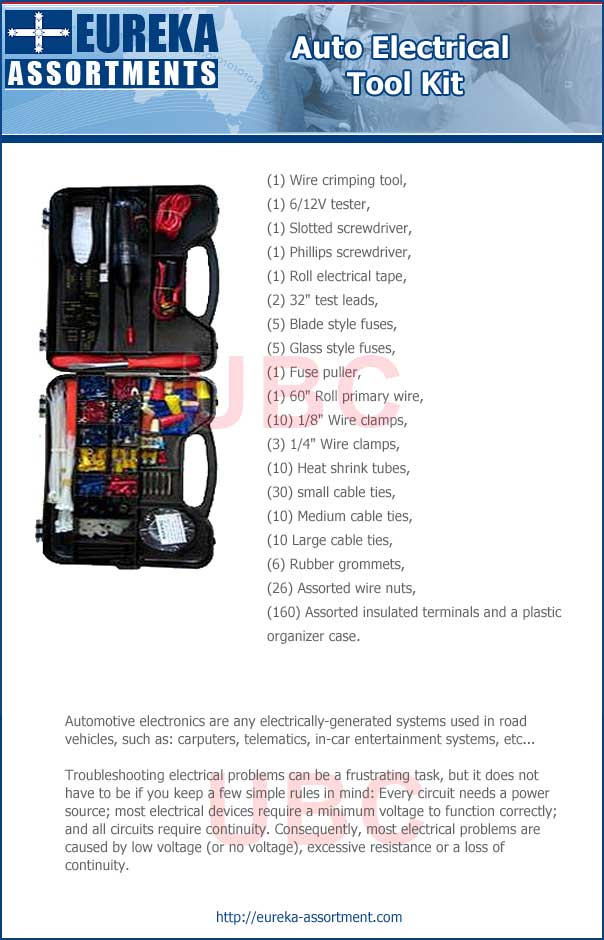
Wire crimping tool, 6-12V tester, Slotted screwdriver, Phillips screwdriver, Roll electrical tape, 32 test leads, Blade style fuses, Glass style fuses, Fuse puller, 60 Roll primary wire, 1-8 Wire clamps, 1-4 Wire clamps, Heat shrink tubes, small cable ties, Medium cable ties, Large cable ties, Rubber grommets, Assorted wire nuts, Assorted insulated terminals and a plastic organizer case.
Automotive electronics are any electrically-generated systems used in road vehicles, such as: carputers, telematics, in-car entertainment systems, etc...
Troubleshooting electrical problems can be a frustrating task, but it does not have to be if you keep a few simple rules in mind: Every circuit needs a power source; most electrical devices require a minimum voltage to function correctly; and all circuits require continuity. Consequently, most electrical problems are caused by low voltage (or no voltage), excessive resistance or a loss of continuity.
CAUTION: When doing electrical repairs or replacing electrical or electronic component, the battery should ALWAYS be disconnected to eliminate any risk of causing an accidental short. Disconnecting the battery will cause most PCMs to forget their learned settings. This may cause driveability issues or require a special elearn procedure with a scan tool, so to avoid this kind of hassle use a 9 volt memory saver that plugs into the vehicles power receptacle (cigarette lighter) to maintain voltage to the battery, or connect a 9 volt alkaline battery to the PCM power supply.
Download catalogue
Automotive electronics are any electrically-generated systems used in road vehicles, such as: carputers, telematics, in-car entertainment systems, etc...
Troubleshooting electrical problems can be a frustrating task, but it does not have to be if you keep a few simple rules in mind: Every circuit needs a power source; most electrical devices require a minimum voltage to function correctly; and all circuits require continuity. Consequently, most electrical problems are caused by low voltage (or no voltage), excessive resistance or a loss of continuity.
CAUTION: When doing electrical repairs or replacing electrical or electronic component, the battery should ALWAYS be disconnected to eliminate any risk of causing an accidental short. Disconnecting the battery will cause most PCMs to forget their learned settings. This may cause driveability issues or require a special elearn procedure with a scan tool, so to avoid this kind of hassle use a 9 volt memory saver that plugs into the vehicles power receptacle (cigarette lighter) to maintain voltage to the battery, or connect a 9 volt alkaline battery to the PCM power supply.