
Nut and Bolt SAE
nut and bolt SAE kit 420 piece
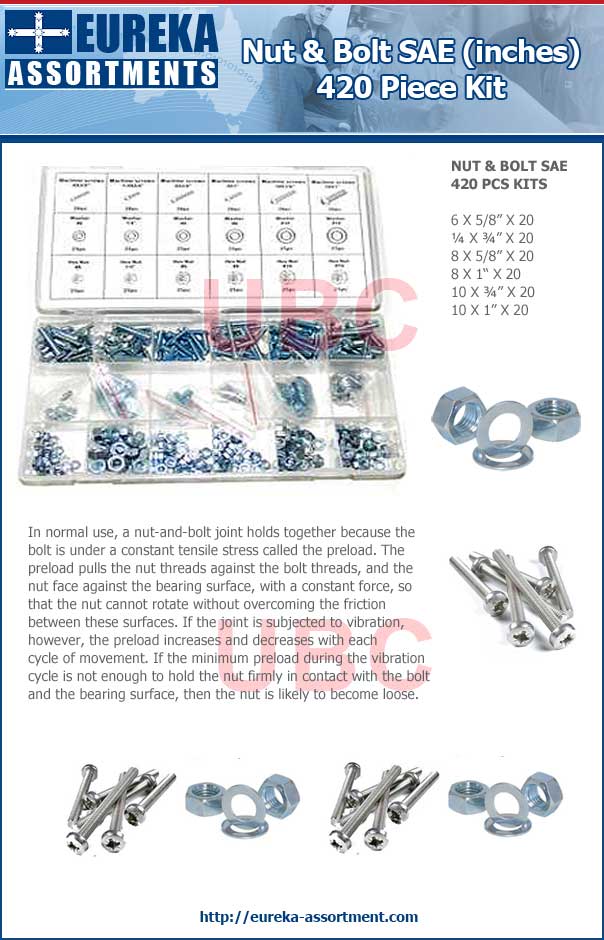
Nut and bolt SAE kit 420 piece. A nut is a type of fastener with a threaded hole. Nuts are almost always used opposite a mating bolt to fasten a stack of parts together. The two partners are kept together by a combination of their threads friction, a slight stretch of the bolt, and compression of the parts.
In applications where vibration or rotation may work a nut loose, various locking mechanisms may be employed: Adhesives, safety pins or lockwire, nylon inserts, or slightly oval-shaped threads. The most common shape is hexagonal, for similar reasons as the bolt head - 6 sides give a good granularity of angles for a tool to approach from (good in tight spots), but more (and smaller) corners would be vulnerable to being rounded off. Other specialized shapes exist for certain needs, such as wing nuts for finger adjustment and captive nuts for inaccessible areas.
In normal use, a nut-and-bolt joint holds together because the bolt is under a constant tensile stress called the preload. The preload pulls the nut threads against the bolt threads, and the nut face against the bearing surface, with a constant force, so that the nut cannot rotate without overcoming the friction between these surfaces. If the joint is subjected to vibration, however, the preload increases and decreases with each cycle of movement. If the minimum preload during the vibration cycle is not enough to hold the nut firmly in contact with the bolt and the bearing surface, then the nut is likely to become loose.
Specialized locking nuts exist to prevent this problem, but sometimes it is sufficient to add a second nut. For this technique to be reliable, each nut must be tightened to the correct torque. The inner nut is tightened to about a quarter to a half of the torque of the outer nut. It is then held in place by a wrench while the outer nut is tightened on top using the full torque. This arrangement causes the two nuts to push on each other, creating a tensile stress in the short section of the bolt that lies between them.
Even when the main joint is vibrated, the stress between the two nuts remains constant, thus holding the nut threads in constant contact with the bolt threads and preventing self-loosening. When the joint is assembled correctly, the outer nut bears the full tension of the joint. The inner nut functions merely to add a small additional force to the outer nut and does not need to be as strong, so a thin nut (also called a jam nut) can be used.
Bolts are used to join pieces together either permanently or temporarily. Many steel structures, including buildings, are simply bolted together. For example, the Eiffel Tower in Paris was originally a temporary structure and after twenty years it was to be dismantled. For this reason most of the steel components were bolted together. However, the tower has lasted well over a hundred years. Much of the structure of the Empire State Building in the USA is also bolted together. Nuts and bolts can also be used to fix together small structures such as furniture. Nuts and bolts come in many different types and sizes and some are shown below
Download catalogue
In applications where vibration or rotation may work a nut loose, various locking mechanisms may be employed: Adhesives, safety pins or lockwire, nylon inserts, or slightly oval-shaped threads. The most common shape is hexagonal, for similar reasons as the bolt head - 6 sides give a good granularity of angles for a tool to approach from (good in tight spots), but more (and smaller) corners would be vulnerable to being rounded off. Other specialized shapes exist for certain needs, such as wing nuts for finger adjustment and captive nuts for inaccessible areas.
In normal use, a nut-and-bolt joint holds together because the bolt is under a constant tensile stress called the preload. The preload pulls the nut threads against the bolt threads, and the nut face against the bearing surface, with a constant force, so that the nut cannot rotate without overcoming the friction between these surfaces. If the joint is subjected to vibration, however, the preload increases and decreases with each cycle of movement. If the minimum preload during the vibration cycle is not enough to hold the nut firmly in contact with the bolt and the bearing surface, then the nut is likely to become loose.
Specialized locking nuts exist to prevent this problem, but sometimes it is sufficient to add a second nut. For this technique to be reliable, each nut must be tightened to the correct torque. The inner nut is tightened to about a quarter to a half of the torque of the outer nut. It is then held in place by a wrench while the outer nut is tightened on top using the full torque. This arrangement causes the two nuts to push on each other, creating a tensile stress in the short section of the bolt that lies between them.
Even when the main joint is vibrated, the stress between the two nuts remains constant, thus holding the nut threads in constant contact with the bolt threads and preventing self-loosening. When the joint is assembled correctly, the outer nut bears the full tension of the joint. The inner nut functions merely to add a small additional force to the outer nut and does not need to be as strong, so a thin nut (also called a jam nut) can be used.
Bolts are used to join pieces together either permanently or temporarily. Many steel structures, including buildings, are simply bolted together. For example, the Eiffel Tower in Paris was originally a temporary structure and after twenty years it was to be dismantled. For this reason most of the steel components were bolted together. However, the tower has lasted well over a hundred years. Much of the structure of the Empire State Building in the USA is also bolted together. Nuts and bolts can also be used to fix together small structures such as furniture. Nuts and bolts come in many different types and sizes and some are shown below