
Split Pin - Cotter Pin Kit
split pin cotter pin kit 280 piece, sizes, 280 Piece Kit, 1/16x1â€, 3/32x1.1/2â€, 1/8x2â€, 3/32x1†, 1/8x1.1/4â€, 5/32x2.1/2â€
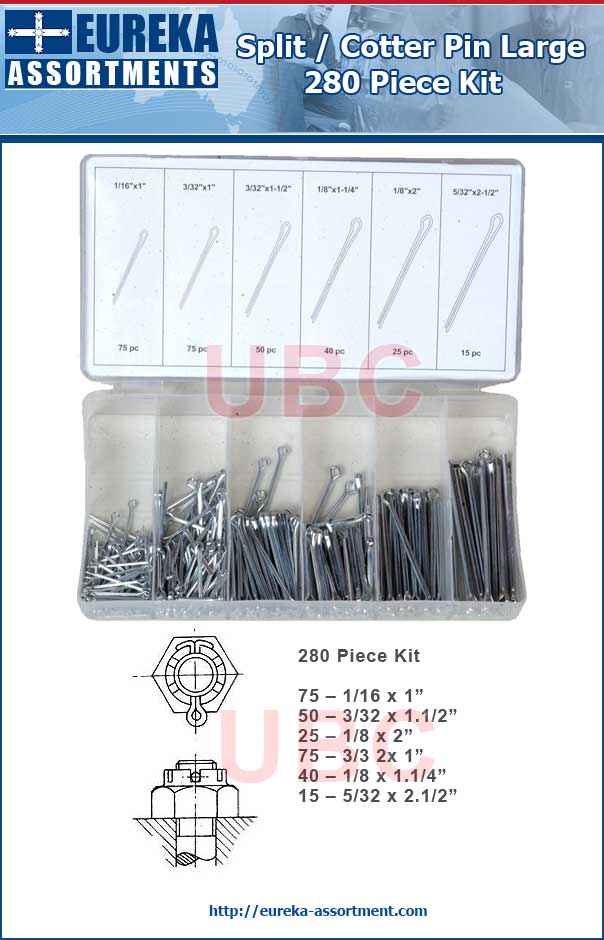
Split pin and cotter pin kit 280 piece. A split pin, also known in the United States as a cotter pin or cotter key, is a metal fastener with two tines that are bent during installation, similar to a staple or rivet. Typically made of thick wire with a half-circular cross section, split pins come in multiple sizes and types.
The British definition of cotter pin is equivalent to U.S. term cotter, which can be a cause for confusion when companies of both countries work together. There are signs that manufacturers and stockists are increasingly listing both names together to avoid confusion; this led to the term split cotter sometimes being used for a split pin.
Split pins are typically made of soft metal, making them easy to install and remove, but also making it inadvisable to use them to resist strong shear forces. Common materials include mild steel, brass, bronze, stainless steel, and aluminum.
Split pins are frequently used to secure other fasteners, e.g. clevis pins, as well as being used in combination with hardboard discs as a traditional joining technique for teddy bears. A common application of this is when used to secure a castellated nut.
Split pins are also very common as they are easy to use and effective. Often they are found on self-assembly trolleys, light wheel barrows, lawn mowers and similar items. They are usually made from ‘soft’ steel or aluminum and they come in a range of sizes.
Download catalogue
The British definition of cotter pin is equivalent to U.S. term cotter, which can be a cause for confusion when companies of both countries work together. There are signs that manufacturers and stockists are increasingly listing both names together to avoid confusion; this led to the term split cotter sometimes being used for a split pin.
Split pins are typically made of soft metal, making them easy to install and remove, but also making it inadvisable to use them to resist strong shear forces. Common materials include mild steel, brass, bronze, stainless steel, and aluminum.
Split pins are frequently used to secure other fasteners, e.g. clevis pins, as well as being used in combination with hardboard discs as a traditional joining technique for teddy bears. A common application of this is when used to secure a castellated nut.
Split pins are also very common as they are easy to use and effective. Often they are found on self-assembly trolleys, light wheel barrows, lawn mowers and similar items. They are usually made from ‘soft’ steel or aluminum and they come in a range of sizes.